
There is a particular kind of conversation that happens around the Lupin office when a new destination is being considered. It usually starts with someone returning from a trip and saying, “You know, we should really think about adding —” and then a long list of reasons why we probably will not, followed by a longer one of reasons why we should.
Tunisia took us almost two years of conversations. We have now added it to our map. This is the story of why.
The short version: Tunisia is, today, one of the most underpriced destinations in the Mediterranean for the kind of traveller we work with. Carthage sits forty minutes from Tunis Airport. The blue-and-white village of Sidi Bou Said is the most photogenic Mediterranean town that no one is photographing for Instagram. The Bardo Museum holds the largest mosaic collection on earth. And the entire country can be experienced — properly, without compromise — for roughly half what the same trip would cost in Italy or France.
But “underpriced” is not why we added it. We added Tunisia because of what happens when you stand in the right place there.

The Country Most Travellers Forgot
Tunisia was, for much of the twentieth century, one of the most popular Mediterranean destinations for European travellers. French families summered in Hammamet. British families flew to Sousse. The country was synonymous with sun, ruins, and a particular kind of unhurried North African elegance.
Then, for nearly a decade, the high-end traveller went elsewhere. Tunisia did not disappear — millions of European visitors still came every year — but the kind of slow, considered, culturally serious traveller we work with largely stopped including it on their map.
That has changed. The country we visited over the last eighteen months is not the Tunisia of the package-tour years, and it is not the Tunisia of the cautious decade that followed. It is something else: a confident, beautifully maintained, deeply hospitable country that has learned to receive travellers on its own terms.
What surprised us most was not the change. It was the realisation of how much the country had been undersold even when it was popular. The Tunisia we now know is closer to a quiet Sicily than to anything its old reputation suggested.
Why Carthage, Specifically
Most travellers who visit Tunisia today head to the southern beaches or the Sahara. Both have their place. But our journeys begin in Carthage, and they begin there for a specific reason.
Carthage is the only place on earth where you can stand inside three Mediterranean civilisations at once.
Walk the Punic Ports — the harbour where Hannibal’s fleet was built — and you are in Phoenician Carthage, the city that nearly destroyed Rome before Rome destroyed it. Cross a road and you are in Roman Carthage, the second city of the Empire after Rome itself, with baths the size of cathedrals. Continue another fifteen minutes and you are in Byzantine and early Christian Carthage, where the Mediterranean’s deepest mosaic traditions were born.
This layering — three civilisations on the same hill — exists nowhere else in the way it exists here. Rome has Rome. Athens has Greece. Istanbul has Constantinople. Carthage has all three Mediterranean ages stacked on a single coastal ridge, with the bay of Tunis spreading below.
For travellers who already know Italy, Greece, and Turkey, Carthage is the missing piece — the part of the Mediterranean story that does not appear on any of the more famous itineraries.

Sidi Bou Said: The Village Time Politely Forgot
Six minutes by car from the Carthage ruins sits a small village that became, almost by accident, one of the most beautiful places in the Mediterranean.
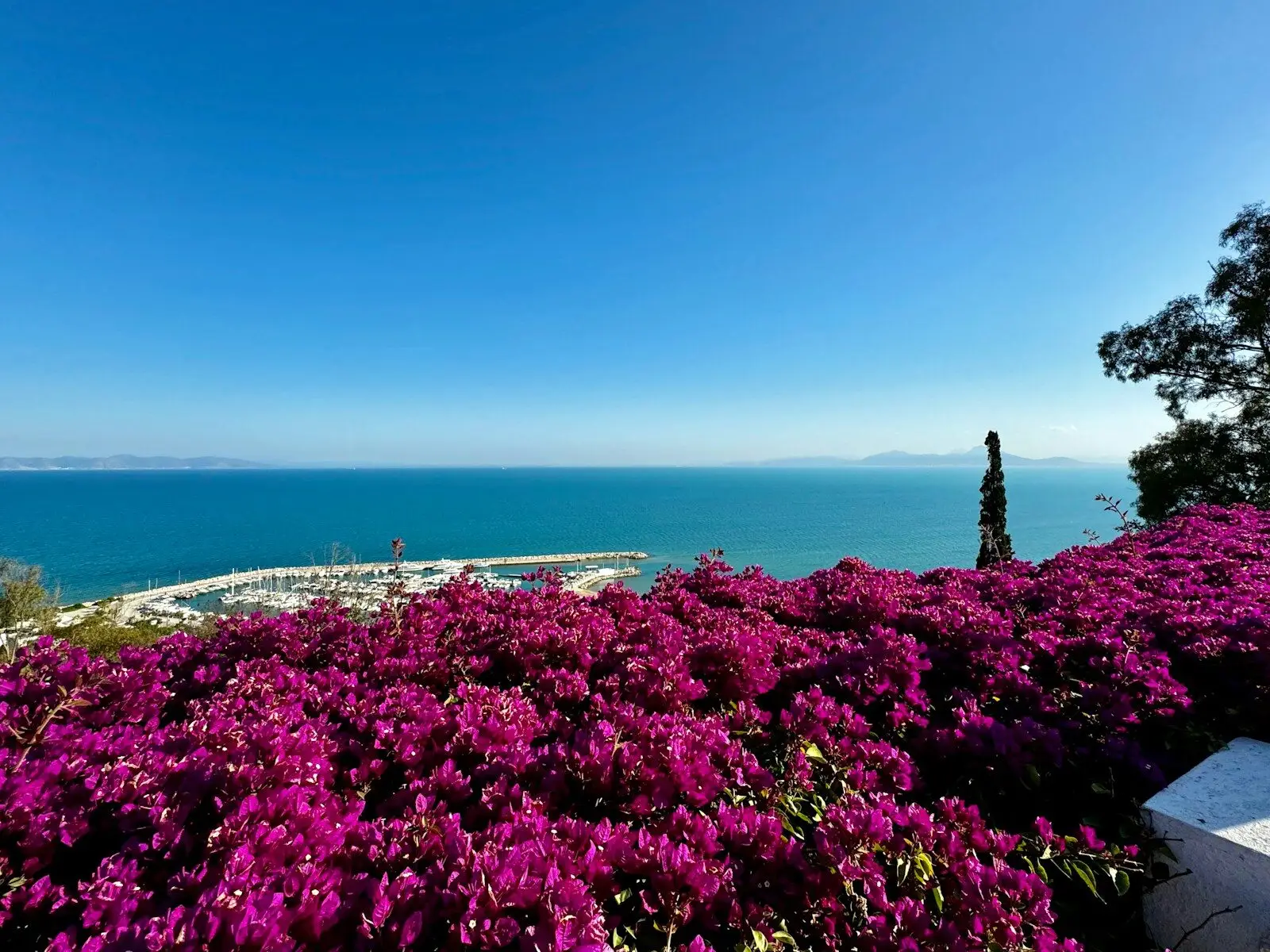
Sidi Bou Said is all blue and white, by law. The colour scheme — cobalt-blue shutters and doors against whitewashed walls, set into the cliff above the bay of Tunis — was preserved by a French baron in the 1920s who fell in love with the village and bought enough property to dictate its aesthetic permanently. A century later, the rule still holds. Walk any street and the only colours you will see are blue, white, the bougainvillea spilling over walls, and the sea.
The village has been quietly hosting writers and painters for a hundred years — Paul Klee painted here, André Gide wrote here, Michel Foucault retreated here. It is the kind of place where time moves in cafés rather than minutes. The right way to spend a morning is at Café des Délices, mint tea with pine nuts, watching the bay below. The right way to spend an afternoon is the village’s small galleries and the houses-turned-museums that explain what life here looked like in the eighteenth century.
We stay our guests at Dar Said — a nineteenth-century residence with twenty-four rooms set around inner courtyards, a small hammam, and a garden of bougainvillea that frames sunrise over the Mediterranean. There are larger luxury hotels in the area. None of them feel as completely Tunisian as this one.
The Bardo: A Museum That Should Be Better Known
Forty minutes from Sidi Bou Said, in a former Beylical palace, sits a museum that holds the largest collection of Roman mosaics in the world.
This is not a slight collection or a regional one. The Bardo National Museum has the most important mosaic holdings on earth — fragments of villas and bath complexes from across Roman North Africa, assembled across centuries of excavation, displayed in palace halls that are themselves works of art. The famous Virgil Mosaic — the only contemporary depiction of the Roman poet — is here. So are mosaics from Dougga, Sousse, El Djem, and Carthage that would be the centrepiece of any other museum.
The visitor experience is closer to the Cairo Museum before the Grand Egyptian opened: profoundly important, slightly under-curated for a foreign audience, with rooms that feel like they have been waiting for you specifically.
A private tour with a Tunisian archaeologist transforms it. We arrange these as the standard rather than the exception.

El Djem: The Amphitheatre That Stopped Us
Three hours south of Tunis, in a quiet town surrounded by olive groves, stands the third-largest Roman amphitheatre ever built.
El Djem — ancient Thysdrus — is a structure most travellers have never heard of, and it is enormous. Larger than the Verona Arena. Better preserved than Pula. With substructures that you can actually walk through, including the chambers where gladiators waited and the pulley systems that lifted them into the arena floor.
Standing inside it is one of those moments where you find yourself rearranging your sense of the Roman world. Most travellers spend their lives believing the Colosseum was the Empire’s grandest provincial monument. El Djem suggests otherwise.
The town around it is sleepy. There are no crowds. On most mornings you can have the entire amphitheatre to yourself for a stretch of time — something that has not been possible at the Colosseum for fifty years.
What Tunisia Is Not
A new destination on our map deserves the same honesty as the established ones, so:
Tunisia is not a beach-resort country, even though it has beaches. The travellers who arrive expecting Bodrum or Mykonos misunderstand the assignment. Tunisia’s pleasure is cultural and culinary, with the sea as background, not headline.
Tunisia is not a country for travellers who need an extensive luxury hotel inventory. There are excellent boutique hotels — Dar Said, Maison Dedine, the right villas in Sidi Bou Said — but the choice is narrower than in Greece or Turkey. This is changing, but slowly.
Tunisia is not a country to combine with too much else. Pairing it with Egypt makes sense — both ancient North African capitals, both layered civilisations — and we will design that journey when asked. But adding Tunisia to a Turkey-Egypt trip stretches it past where most travellers want to go. Tunisia rewards travellers who give it five to seven nights of its own.
What Tunisia Is
A country where you can spend a morning inside three Mediterranean civilisations, an afternoon in the most photogenic blue-and-white village on earth, and an evening on a hotel rooftop watching the sun fall behind the bay of Tunis. Where the Roman amphitheatre you stand inside is largely empty. Where the museum you visit holds objects that would be the headline of the Louvre.
A country whose food is North African Mediterranean at its most thoughtful — brik à l’oeuf, slow-cooked tagines, harissa-warmed salade tunisienne, the fish grilled simply because the fish does not need help.
A country that has been visited for three thousand years and still has rooms left to discover.

A Sample 6-Night Tunisia Journey
This is the shape of the journey we have been building for our first guests. As always, it is a frame, not a prescription.
Days 1–3: Sidi Bou Said and Carthage
Arrival at Tunis-Carthage Airport. Three nights at Dar Said. A private morning at the Carthage ruins with an archaeologist. An afternoon at the Punic Ports. A long lunch at La Falaise overlooking the bay. A second day for the Bardo Museum and Tunis Medina. A third day for slowness — a hammam in Sidi Bou Said, an afternoon in the village’s galleries, dinner at Dar El Jeld in the old city.
Days 4–5: South to El Djem and Sousse
A drive south, with stops at Hammamet for an early lunch and the Roman ruins at Thuburbo Majus. Two nights in Sousse or a quiet Mahdia boutique stay. A morning entirely at El Djem amphitheatre. The mosaic museum at Sousse. A coastal sunset.
Days 6–7: The Sahara fringe (optional) or return to Tunis
For travellers who want the full arc, a flight to Tozeur and a single night at a desert lodge — the dunes of Ksar Ghilane or the salt flats of Chott el Djerid. For travellers who prefer to keep the trip Mediterranean, a return to Sidi Bou Said for a final night of slow village life.
Day 7 or 8: Departure.
The Wider Map
Adding Tunisia to our destinations is not, for us, a matter of growing a list. It is a recognition that the Mediterranean we work in — Turkey, Greece, Egypt — has a fourth corner that we have been quietly underserving.
The traveller who has done Istanbul, who has sailed the Aegean, who knows the Pyramids — that traveller is the one for whom Carthage now matters most. The story of the ancient Mediterranean is incomplete without it. We have spent enough time in the country to know we can deliver it the way we deliver Cappadocia and Cairo: with the right doors, the right guides, the right hotels, and the right pace.
If Tunisia has been on your mental list — or if it has not, and you are now reconsidering — the conversation is open. We are accepting our first season of bookings, and the early travellers will, as always, get the deepest version of what we know.
Considering Tunisia for a private journey? Get in touch with our team — we are now taking bookings for our first full Tunisia season, with itineraries designed around the country we have spent the last two years getting to know.